If you’ve ever walked through a precision parts manufacturing floor, you’ve probably heard a compound grinding machine hum away in a corner—powerful, precise, and the unsung workhorse behind parts that have to fit perfectly, no exceptions. As a supplier of these machines, I get asked one question more than any other: how do they actually handle such different surface finishes, from the ultra-smooth mirror-like on medical implants to the slightly matte, consistent texture on automotive engine components? Let me break this down, straight from the shop floor and the thousands of installations we’ve supported over the years. Compound Grinding Machine
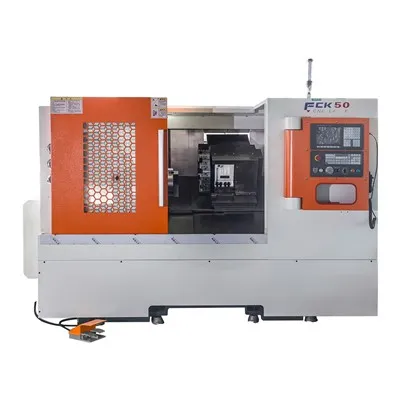
First, let’s get one thing straight: a compound grinding machine isn’t just a single tool—it’s a system built to adapt. Unlike a basic surface grinder that only does one type of pass, our compound models integrate multiple grinding operations into a single setup, which means we can tune every part of the process to hit a specific finish target. The surface finish of a ground part is measured by two key numbers: Ra (the average roughness across the surface) and Rz (the maximum peak-to-valley height). A medical hip implant might need an Ra of 0.02 micrometers, while a car’s brake rotor might run at 0.8 micrometers. The machine has to adjust dynamically to hit those marks without wasting time or wearing out tools unnecessarily.
Let’s start with the grinding wheels—this is where the magic really happens. Not all grinding wheels are the same, and picking the right one is the first step to controlling finish. For ultra-smooth finishes, we use wheels with very fine abrasive grains, sometimes as small as 1 micrometer. For rougher, more durable finishes, we coarser grains that remove material faster. But it’s not just about grain size; the bond that holds the grains in place matters too. A vitrified bond is hard and rigid, which keeps grains in place for consistent finishes, while a resin bond is more flexible, which is great for parts with curved surfaces that need to maintain uniform texture without scratches. I remember a customer who makes heart stents—they switched from our standard vitrified wheels to our diamond-impregnated resin wheels, and their Ra dropped from 0.05 micrometers to 0.018, exactly what the FDA requires. That kind of result is what makes tuning the wheel so critical.
Next, there’s the machine’s CNC control system, which is the brain that adapts the process in real time. Compound grinding machines can switch between roughing, semi-finishing, and finishing passes automatically, but we program those passes to match the finish needed. Roughing passes remove the majority of the material fast, with a deeper cut and higher feed rate—this leaves a rougher surface, but it’s efficient. Semi-finishing passes take lighter cuts, reducing the peak-to-valley height, and finishing passes are the lightest of all, with cuts that might only be a few thousandths of a millimeter deep. The control system also adjusts the wheel speed and table speed (the speed the part moves past the wheel) on the fly. For a mirror finish, we slow the table down so each abrasive grain has more time to cut cleanly, rather than scraping and leaving marks. For a brake rotor, we speed things up to keep production moving, since that part doesn’t need an ultra-smooth finish—just a consistent one that stops a car safely.
Cooling and lubrication are another piece of the puzzle that people don’t always think about, but they make a huge difference in surface finish. When you grind a part, friction between the wheel and the part generates a lot of heat. If that heat isn’t removed, it can cause the part to warp, or leave burns on the surface that ruin the finish. For delicate parts like aerospace turbine blades, we use a high-pressure, high-flow coolant system that floods the grinding zone directly, with coolant that’s filtered to a precision that removes particles as small as 0.5 micrometers. Even a tiny metal particle in the coolant can get caught between the wheel and the part, leaving a scratch. For parts that need a matte, non-reflective finish, we use a less aggressive lubricant that creates a thin layer between the wheel and part, reducing friction just enough to keep cuts consistent without making the surface too smooth.
One of the biggest advantages of compound grinding machines is their ability to handle different part geometries without losing finish quality. Some parts are flat, some are cylindrical, some have complex 3D contours like mold cavities for plastic bottles. Our machines are equipped with multiple axes of movement, so the wheel can follow the exact shape of the part as it grinds, rather than just moving in straight lines. For a mold insert that needs a uniform matte finish across a deep, curved surface, we program the machine to adjust the wheel’s angle and speed as it moves down the curve, so every point on the surface gets the same amount of material removed, no hot spots or uneven texture. I once worked with a toolmaker who was struggling to get a consistent finish on a set of 100 mold inserts for food containers—his old machine would leave a rougher patch at the bottom of each curve. We updated his compound machine’s contouring software and adjusted the wheel path, and all 100 parts came out within 0.02 micrometers of Ra, exactly what their customer required for easy releasing of plastic without marks.
We also have features to compensate for wear on the grinding wheel, which is a common cause of inconsistent finishes. As you grind, the abrasive grains on the wheel get dull, which makes them scrape instead of cut, leading to a rougher surface. Compound grinding machines have automatic dressing systems that true and dress the wheel during production, so the grains stay sharp and the wheel maintains its shape. For a customer making hydraulic valves, where a leak can cause a whole system to fail, consistent finish is non-negotiable. Their machine dresses the wheel every 50 parts, and the control system adjusts the dressing depth based on how many parts have been run, so every valve’s sealing surface has the same Ra of 0.03 micrometers, even after months of production.
Of course, every industry has unique requirements, and a good compound grinding machine has to be flexible enough to meet them. Let’s take three common examples to make this concrete. First, medical implants: let’s say a femoral hip stem. It has a smooth, polished area where the ball fits into the socket, and a slightly rougher, textured area where bone grows in to hold the implant in place. A compound grinding machine can do both operations in one setup—grind the polished area with a fine diamond wheel and ultra-light finishing passes, then switch to a coarser aluminum oxide wheel with a specific surface pattern on the textured area, all without removing the part from the machine. That cuts down on setup time and eliminates the risk of damaging the polished surface when moving the part to a different machine.
Second, automotive engine cylinder blocks. The cylinder walls need a cross-hatch finish—slightly rough, but with tiny grooves that hold oil to lubricate the piston rings. That finish is measured by a specific profile, not just Ra. Compound grinding machines for automotive use are programmed to create that exact cross-hatch angle, usually around 30 degrees, by adjusting the table speed and wheel speed during the finishing pass. The machine also has a way to measure the finish in real time, using an inline surface roughness sensor, so if the cross-hatch is off by even a degree, it adjusts the path automatically. That’s critical because a bad cross-hatch leads to oil consumption and engine failure.
Third, aerospace turbine blades. These parts are made from high-temperature alloys that are hard to grind, and their surfaces need to be smooth enough to reduce drag, but also resistant to corrosion and fatigue. Compound grinding machines for aerospace use use high-speed wheels, sometimes running at 10,000 RPM, to cut through hard alloys without generating too much heat. We also use special cryogenic cooling for these parts—liquid nitrogen is sprayed on the grinding zone, which keeps the part cool and prevents thermal damage, leading to a finish that’s not only smooth but also more durable, extending the life of the turbine.
I’ll be honest, it’s not just the machine itself—its how you integrate it into your process that makes the difference. A compound grinding machine is only as good as the programming, the setup, and the maintenance you put into it. That’s why as a supplier, we don’t just sell the machine—we work with our customers to tune every part of the process. If a customer says they need a specific finish for a new part, we’ll run test parts on our demo floor, adjust the wheel, the passes, the coolant, until we get exactly what they need. We’ve had customers come to us with parts that another machine couldn’t get within 0.1 micrometers of their target, and we delivered parts that hit the mark on the first try.
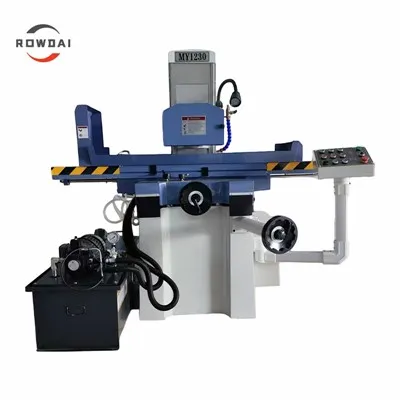
If you’re reading this and you’re tired of inconsistent surface finishes, long setup times, or parts that fail inspection because of bad grinding, I’d encourage you to reach out to talk about your specific needs. Every application is different, and a one-size-fits-all approach doesn’t work for surface finish. Whether you’re making medical devices, automotive parts, aerospace components, or anything that needs precision grinding, a compound grinding machine can be adjusted to get exactly the finish you need, and keep production running efficiently.
Surface Grinding Machine References
- Mario C. Shaw, Principles of Abrasive Processing, Oxford University Press, 1996.
- George T. Smith, Abrasive Technology: Principles and Applications, Springer, 2007.
- DIN EN ISO 3274:2017, Geometrical Product Specifications (GPS) – Surface texture: Profile method – Nominal characteristics of contact (stylus) instruments.
- ASME B46.1-2019, Surface Texture (Surface Roughness, Waviness, and Lay).
Henan Rowdai Machinery Equipment Co., Ltd.
As one of the most professional compound grinding machine manufacturers in China, we’re featured by quality products and good price. Please rest assured to buy high-grade compound grinding machine for sale here from our factory. If you have any enquiry about cooperation, please feel free to email us.
Address: Building 9, E-Commerce Industrial Park, High-Tech Zone, Zhengzhou, Henan, China
E-mail: rowdai@rowdai.com
WebSite: https://www.rowdai.com/
