If you’re reading this, chances are you’re either a diaper manufacturer exploring ways to modernize your production line, a supplier like me who’s spent years tuning every part of the adult diaper machinery, or someone who’s wondered how a machine that makes such a personal product could keep up with today’s demand for smart manufacturing. For the last 12 years, I’ve worked hands-on with adult diaper machines—first as a lead technician at a packaging equipment firm, then as the head of product development for my own company, where we design, build, and service high-speed lines for disposable hygiene products. Over that time, the question I get more than any other from existing and new clients is this: Does an adult diaper machine support remote monitoring and management? ADULT DIAPER MACHINE
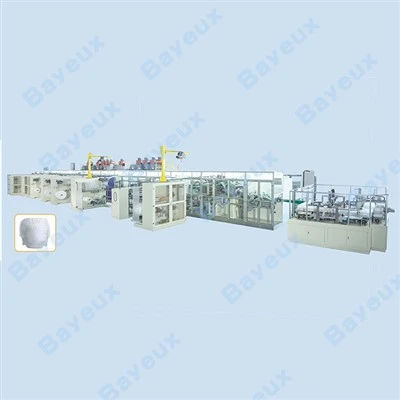
The short answer is yes—but it’s not a one-size-fits-all feature. When we started integrating remote tech into our machines back in 2018, it was mostly a nice-to-have for large factories with 24/7 production. Today, it’s a core requirement for mid-sized plants that can’t afford to have a technician drive 3 hours to fix a paper jam or a misaligned elastic band at 2 a.m. Let me walk you through how this works, what it actually does for a production floor, and why it’s non-negotiable in 2024.
First, let’s break down what remote monitoring and management (RMM) means for an adult diaper machine, not just a generic industrial piece of equipment. A modern adult diaper line is a symphony of dozens of moving parts: the unwinding rolls of non-woven fabric, the elastic stretchers, the core-forming station that mixes fluff pulp and superabsorbent polymer (SAP), the sealing and cutting blades, and the packaging unit that stacks finished diapers into packs. Each of these parts has sensors that track speed, temperature, tension, and alignment—all calibrated to within millimeters to avoid defects like leaks, broken elastic, or uneven seals that lead to product recalls.
Before RMM, if a sensor picked up a tension drop on the fabric roll, the operator would have to stop the line, open the guard, adjust the roll, and hope the rest of the run was good. With remote monitoring, those same sensors send real-time data to a cloud-based dashboard, which alerts technicians the second a value falls outside the acceptable range. Last year, one of our clients in rural Ohio had a line that was dropping 12 defective diapers per hour because of a worn knife blade—before RMM, they would have only noticed the issue during a 30-minute mid-shift quality check, wasting 360 diapers, stopping the line for knife replacement twice, and missing a 10,000-unit production quota. With remote alerts, the technician got a notification while the line was still running, adjusted the blade tension remotely, and avoided over 1,000 defective units in just one day. That’s the kind of impact we’re talking about.
But remote monitoring is just the first step. Remote management goes further: it lets authorized technicians adjust machine settings, run diagnostic tests, and even update software all without being on-site. For example, when the FDA updated labeling requirements for adult incontinence products in 2022, several of our clients needed to reconfigure their printing units to add new ingredient and care warnings. A large plant in Texas had three lines running three different SKUs, each needing a 10-minute software tweak to their print heads. Without remote management, that would have required two service technicians to fly in, spend two days on-site, and disrupt 12 hours of production. With our RMM system, we connected to each line remotely, pushed the new firmware, calibrated the print settings for each SKU, and were done in under an hour. The client saved over $80,000 in lost production and travel costs alone.
Of course, this tech isn’t for every machine. If you have a 15-year-old, manually operated adult diaper line with no digital sensors, retrofitting RMM would require installing new hardware, rewiring, and re-calibrating the entire line—something that might not make financial sense for low-volume production. But for anyone investing in a new line or upgrading an existing one in the last five years, RMM is standard, not an add-on. We also offer hybrid options: for older lines, we can install plug-and-play sensor kits that connect to our cloud platform, even if the original machine manufacturer didn’t build RMM into the design.
Now, let’s address the myths I hear all the time, because as someone who’s spent time on factory floors, I know skepticism about new tech is well-earned. First myth: “Remote management is a security risk—someone could hack my line.” That was a big concern in the early days of smart manufacturing, especially for companies that handle sensitive production data and product designs. To combat that, our RMM system uses end-to-end encryption, two-factor authentication for all access, and a closed network connection that doesn’t expose the machine to the wider internet. We also never store raw production data on our servers unless the client opts in, and all access is logged with timestamps and user IDs—so if something does go wrong, you can trace exactly who adjusted a setting and when. In six years of using this system, we’ve never had a security breach, and all our clients have gone through third-party security audits with zero findings.
Second myth: “I don’t have the IT team to handle this—remote monitoring is too complicated.” That’s a fair point, which is why our RMM system is designed to be simple for plant managers, not just IT specialists. The dashboard is color-coded: green means all systems are running, yellow means a minor alert (like a fabric roll getting low), red means a critical issue (like a temperature spike in the SAP dryer). We also send alerts to multiple contacts—plant managers, shift supervisors, and our service team—via SMS, email, or in-app notifications, so you don’t have to stare at a screen all day. We also provide 24/7 support for anyone using the system, and every client gets a dedicated account manager who can walk them through any dashboard feature in 15 minutes or less.
Another big benefit of RMM for adult diaper machines is predictive maintenance, which is a game-changer for production reliability. Traditional maintenance schedules are fixed: you replace a part every 1,000 hours of run time, regardless of how it’s actually performing. With data from RMM, the machine can track the wear on a blade, the tension on a belt, or the calibration of a seal, and tell you exactly when a part needs to be replaced—weeks before it breaks. Last year, a client in Michigan used our system to track the wear on their cutting blades; the system predicted a blade failure in 12 days, so the technician scheduled a replacement during a planned 2-hour shift break, instead of the line stopping for 4 hours at 1 a.m. when a blade broke unexpectedly. That one adjustment saved them over $150,000 in lost revenue and emergency service costs in a year.
It’s important to note that RMM isn’t just for large-scale manufacturers. We’ve worked with mid-sized producers that run 2-3 lines, and even small boutique brands that specialize in specialty adult diapers (like overnight or heavy-absorbency lines). For a boutique brand that only runs one line, being able to monitor it from a home office or a remote warehouse means you don’t have to hire a full-time technician to be on-site every day. You can check in on production, adjust settings for a new SKU, or address a small issue before it becomes a big problem—all while you’re managing marketing, sales, and quality control.
I’ll be honest: when we first started offering RMM with our machines, there was a learning curve. Some clients wanted to stick with the old way of doing things, and others worried that remote access would replace on-site technicians. But what we’ve found is the opposite: RMM makes technicians more efficient, not less. Instead of spending 8 hours driving to a client’s plant for a simple diagnostic, a technician can fix an issue in 15 minutes remotely, and reserve their on-site time for more complex repairs or preventive maintenance that requires being on the floor. That means faster response times, lower service costs, and less downtime for everyone.
Now, if you’re thinking about upgrading or purchasing a new adult diaper machine, here are a few things to ask your supplier to make sure the RMM system works for you. First, ask if the system is cloud-based or on-premise. Cloud-based systems are more flexible, let you access data from anywhere, and are easier to update. On-premise systems give you more control over data storage, but they’re more expensive to set up and maintain. Second, ask what kind of alerts you get: can you customize alerts for specific parts, like the SAP core station or the sealing unit? Third, ask about compatibility with future upgrades: can you add new sensors or software features as your production needs change, without having to replace the entire RMM system?
I’ve seen too many production lines shut down for days because of a preventable issue—a worn part, a misaligned sensor, a software glitch—that could have been fixed remotely. Adult diaper manufacturers operate on tight margins, deal with strict quality standards, and face constant pressure to adapt to changing consumer needs. Remote monitoring and management isn’t just a nice feature for their machines—it’s a tool that helps them stay competitive, reduce costs, and deliver a consistent, high-quality product to their customers.

If you’re ready to learn more about how our adult diaper machines integrate with reliable, secure remote monitoring and management, or if you have questions about retrofitting an existing line, we’re here to help. Our team has worked with facilities of all sizes, from small boutique brands to large multinational manufacturers, and we can tailor a solution that fits your production volume, budget, and long-term goals. Whether you’re looking to upgrade a 10-year-old line or invest in a new, high-speed line for growing demand, we can walk you through every step, from installation to ongoing support.
Diapers References
Industrial Internet Consortium. (2021). Smart Manufacturing for Disposable Hygiene Products: Security and Efficiency Frameworks.
European Hygienic Products Association. (2022). Maintenance and Digitalization in Adult Diaper Production Facilities.
U.S. Food and Drug Administration. (2022). Labeling Requirements for Disposable Incontinence Products.
Quanzhou Bayeux Industrial Co., Ltd.
Address: ROOM 805,BUILDING 3,NO,8 XIANGSHAN ROAD, XIANGSHAN COMMUNITY, QINGYANG STREET, JINJIANG QUANZHOU FUJIAN.
E-mail: yeliqun_520@163.com
WebSite: https://www.qzbayeux.com/
